
1. By default, how is IP traffic filtered in a Cisco router?
& blocked in and out of all interfaces
& blocked on all inbound interfaces, but permitted on all outbound interfaces
& permitted in and out of all interfaces
& blocked on all outbound interfaces, but permitted on all inbound interfaces
2. Which three parameters can ACLs use to filter traffic? (Choose three.)
& packet size
& protocol suite
& source address
& destination address
& source router interface
& destination router interface
3. How do Cisco standard ACLs filter traffic?
& by destination UDP port
& by protocol type
& by source IP address
& by source UDP port
& by destination IP address
4. Which two statements are correct about extended ACLs? (Choose two)
& Extended ACLs use a number range from 1-99.
& Extended ACLs end with an implicit permit statement.
& Extended ACLs evaluate the source and destination addresses.
& Port numbers can be used to add greater definition to an ACL.
& Multiple ACLs can be placed on the same interface as long as they are in the same direction.
5. Where should a standard access control list be placed?
& close to the source
& close to the destination
& on an Ethernet port
& on a serial port
6. Which three statements describe ACL processing of packets? (Choose three.)
& An implicit deny any rejects any packet that does not match any ACL statement.
& A packet can either be rejected or forwarded as directed by the statement that is matched.
& A packet that has been denied by one statement can be permitted by a subsequent statement.
& A packet that does not match the conditions of any ACL statements will be forwarded by default.
& Each statement is checked only until a match is detected or until the end of the ACL statement list.
& Each packet is compared to the conditions of every statement in the ACL before a forwarding decision is made.
7. Which two statements are true regarding the significance of the access control list wildcard mask 0.0.0.7? (Choose two.)
& The first 29 bits of a given IP address will be ignored.
& The last 3 bits of a given IP address will be ignored.
& The first 32 bits of a given IP address will be checked.
& The first 29 bits of a given IP address will be checked.
& The last 3 bits of a given IP address will be checked.
8. Which two statements are true regarding the following extended ACL? (Choose two.)
ccess-list 101 deny tcp 172.16.3.0 0.0.0.255 any eq 20
access-list 101 deny tcp 172.16.3.0 0.0.0.255 any eq 21
access-list 101 permit ip any any
& FTP traffic originating from network 172.16.3.0/24 is denied.
& All traffic is implicitly denied.
& FTP traffic destined for the 172.16.3.0/24 network is denied.
& Telnet traffic originating on network 172.16.3.0/24 is denied.
& Web traffic originating from 172.16.3.0 is permitted.
9. Interface s0/0/0 already has an IP ACL applied inbound. What happens when the network administrator attempts to apply a second inbound IP ACL?
& The second ACL is applied to the interface, replacing the first.
& Both ACLs are applied to the interface.
& The network administrator receives an error.
& Only the first ACL remains applied to the interface.
10.
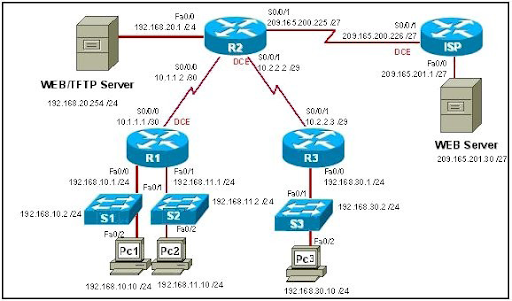
Refer to the exhibit. When creating an extended ACL to deny traffic from the 192.168.30.0 network destined for the Web
& server 209.165.201.30, where is the best location for applying the ACL?
& ISP Fa0/0 outbound
& R2 S0/0/1 inbound
& R3 Fa0/0 inbound
& R3 S0/0/1 outbound
11. Which two statements are true regarding named ACLs? (Choose two.)
& Only named ACLs allow comments.
& Names can be used to help identify the function of the ACL.
& Named ACLs offer more specific filtering options than numbered ACLs.
& Certain complex ACLs, such as reflexive ACLs, must be defined with named ACLs.
& More than one named IP ACL can be configured in each direction on a router interface.
12. Which three items must be configured before a dynamic ACL can become active on a router? (Choose three.)
& extended ACL
& reflexive ACL
& console logging
& authentication
& Telnet connectivity
& user account with a privilege level of 15
13.
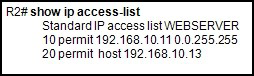
Refer to the exhibit. How does this access list process a packet with the source address 10.1.1.1 and a destination of 192.168.10.13?
& It is allowed because of the implicit deny any.
& It is dropped because it does not match any of the items in the ACL.
& It is allowed because line 10 of the ACL allows packets to 192.168.0.0/16.
& It is allowed because line 20 of the ACL allows packets to the host 192.168.10.13.
14. A network administrator needs to allow traffic through the firewall router for sessions that originate from within the
& company network, but the administrator must block traffic for sessions that originate outside the network of the company.
& What type of ACL is most appropriate?
& dynamic
& port-based
& reflexive
& time-based
15.

Refer to the exhibit. How will Router1 treat traffic matching the time-range requirement of EVERYOTHERDAY?
& TCP traffic entering fa0/0 from 172.16.1.254/24 destined to the 10.1.1.0/24 network is permitted.
& TCP traffic entering fa0/0 from 10.1.1.254/24 destined to the 172.16.1.0/24 network is permitted.
& Telnet traffic entering fa0/0 from 172.16.1.254/24 destined to the 10.1.1.0/24 network is permitted.
& Telnet traffic entering fa0/0 from 10.1.1.254/24 destined to the 172.16.1.0/24 network is permitted.
16. The following commands were entered on a router:
Router(config)# access-list 2 deny 172.16.5.24
Router(config)# access-list 2 permit any
The ACL is correctly applied to an interface. What can be concluded about this set of commands?
& The wildcard mask 0.0.0.0 is assumed.
& The access list statements are misconfigured.
& All nodes on the 172.16.0.0 network will be denied access to other networks.
& No traffic will be allowed to access any nodes or services on the 172.16.0.0 network.
17.
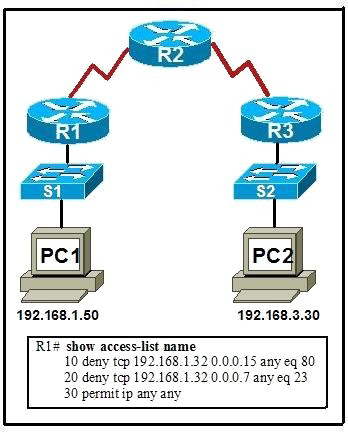
Refer to the exhibit. The administrator wishes to block web traffic from 192.168.1.50 from reaching the default port of the web service on 192.168.3.30. To do this, the access control list name is applied inbound on the router R1 LAN interface. After testing the list, the administrator has noted that the web traffic remains successful. Why is web traffic reaching the destination?
& Web traffic does not use port 80 by default.
& The access list is applied in the wrong direction.
& The access list needs to be placed closer to the destination, on R3.
& The range of source addresses specified in line 10 does not include host 192.168.1.50.
18.
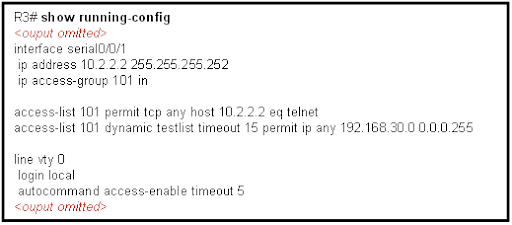
Refer to the exhibit. What will be the effect of the configuration that is shown?
& Users attempting to access hosts in the 192.168.30.0/24 network will be required to telnet to R3.
& Hosts connecting to resources in the 191.68.30.0/24 network have an idle timeout of 15 minutes.
& Anyone attempting to telnet into R3 will have an absolute time limit of five minutes.
& Telnet access to R3 will only be permitted on Serial 0/0/1.
19. Which statement about standard ACLs is true
& Standard ACLS must be numbered and cannot be named.
& They should be placed as close to the destination as possible.
& They can filter based on source and destination address as well as on source and destination port.
& When applied to an outbound interface, incoming packets are processed before they are routed to the outbound interface.
20. Which benefit does an extended ACL offer over a standard ACL?
& Extended ACLs can be named, but standard ACLs cannot.
& Unlike standard ACLs, extended ACLS can be applied in the inbound or outbound direction.
& Based on payload content, an extended ACL can filter packets, such as information in an e-mail or instant message.
& In addition to the source address, an extended ACL can also filter on destination address, destination port, and source port.
21. Which feature will require the use of a named ACL rather than a numbered ACL?
& the ability to filter traffic based on a specific protocol
& the ability to filter traffic based on an entire protocol suite and destination
& the ability to specify source and destination addresses to use when identifying traffic
& the ability to edit the ACL and add additional statements in the middle of the list without removing and re-creating the list
22. A technician is creating an ACL and needs a way to indicate only the subnet 172.16.16.0/21. Which combination of network
& address and wildcard mask will accomplish the desired task?
& 172.16.0.0 0.0.255.255
& 127.16.16.0 0.0.0.255
& 172.16.16.0 0.0.7.255
& 172.16.16.0 0.0.15.255
& 172.16.16.0 0.0.255.255
23. Which two statements accurately describe the characteristics of wildcard masks in an ACL? (Choose two.)
& Wildcard masks are the inverse of the subnet mask.
& The word "any" indicates that all corresponding bits must be matched.
& The word "host" corresponds to a wildcard mask of 0.0.0.0 in an ACL statement.
& A wildcard mask of 0.0.255.255 can be used to create a match for an entire Class B network.
& A wildcard mask bit of 1 indicates that the corresponding bit in the address must be matched.
24.

Refer to the exhibit. Which statement is true about ACL 110 if ACL 110 is applied in the inbound direction on S0/0/0 of R1?
& It will deny TCP traffic to the Internet if the traffic is sourced from the 172.22.10.0/24 network.
& It will not allow TCP traffic coming from the Internet to enter the network 172.22.10.0/24.
& It will allow any TCP traffic from the Internet to enter the network 172.22.10.0/24.
& It will permit any TCP traffic that originated from network 172.22.10.0/24 to return inbound on the S0/0/0 interface.
25.

Refer to the exhibit. ACL 120 is configured inbound on the serial0/0/0 interface on router R1, but the hosts on network 172.11.10.0/24 are able to telnet to network 10.10.0.0/16. On the basis of the provided configuration, what should be done to remedy the problem?
& Apply the ACL outbound on the serial0/0/0 interface on router R1.
& Apply the ACL outbound on the FastEthernet0/0 interface on router R1.
& Include the established keyword at the end of the first line in the ACL.
& Include a statement in the ACL to deny the UDP traffic that originates from 172.11.10.0/24 network.
26.
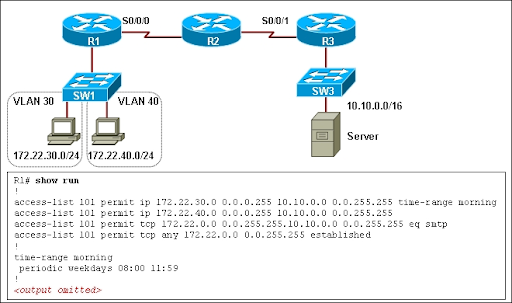
Refer to the exhibit. The network administrator applied an ACL outbound on S0/0/0 on router R1. Immediately after the administrator did so, the users on network 172.22.30.0/24 started complaining that they have intermittent access to the resources available on the server on the 10.10.0.0/16 network. On the basis of the configuration that is provided, what is the possible reason for the problem?
& The ACL allows only the mail traffic to the server; the rest of the traffic is blocked.
& The ACL permits the IP packets for users on network 172.22.30.0/24 only during a specific time range.
& The ACL permits TCP packets only if a connection is established from the server to the network 172.22.0.0/16.
& The ACL allows only TCP traffic from users on network 172.22.40.0/24 to access the server; TCP traffic from any other sources is blocked.
1. Which statements are correct regarding ATM connections? (Choose two.)
• uses only PVCs
• is useful for video transfers
• has data rates beyond 155 Mbps
• cells have 32 byte payload and a 5 byte overhead
• mandates single virtual circuits on a single leased line connection
2. Which of the following describes a packet-switched network using connection-oriented data transfer? (Choose two.)
• Each packet carries an identifier.
• Each packet carries full addressing information.
• Each switch in the route must evaluate the addressing information to determine where to send the packet.
• Each switch determines where to send the packet by examining tables in memory.
• The addressing information is used to set switches along the route of data transfer to create a continuous copper circuit.
3. A European company needs a low cost, dialup WAN connection to validate transactions for point-of-sale card readers. Which connection type is commonly used for this situation?
• ATM
• X.25
• Frame Relay
• Leased lines
4. Which of the following is commonly used as Data Terminal Equipment?
• ISDN
• modem
• router
• CSU/DSU
5. A company requires a WAN connection that will carry 64 kbps and allow fast call setup time. The connection does not need to carry video. What is the best choice for this company?
• ATM
• ISDN BRI
• X.25
• analog dialup
6. Why is it important to identify the type of traffic that will be carried on the WAN links before choosing a WAN technology?
• to determine the routing protocol to be used on the WAN link
• to determine the WAN topology
• to determine the requirements for latency and jitter
• to determine the type of signaling protocol to be used on the WAN link
7. On which of the following are most Layer 2 WAN encapsulations based?
• IP
• PPP
• HDLC
• SLIP
• HSSI
• CSU
8. A company only requires a WAN connection to transfer sales data from individual stores to the home office. All transfers will occur after business hours. They estimate they will never need a connection faster than 56 kbps. Which type of connection is best for this company?
• ATM
• ISDN
• analog dialup
• T1 Leased Line
9. Which of the statements regarding DSL are correct? (Choose three.)
• DSL provides a consistent bandwidth of 2.154 Mbps.
• DSL connections provide a fast dialup to establish a WAN connection.
• DSL connects the local loop to a digital subscriber line access multiplexer.
• DSL bandwidth varies and can exceed the bandwidth of a T1/E1 leased line.
• For DSL to function properly, the local loop must be less than 5.5 kilometers (3.5 miles).
• DSL is a popular choice for enterprises that need to connect home users to the local network due to strong security.
10. Which of the following are disadvantages of circuit-switched networks? (Choose two.)
• Data is subject to unpredictable delays while it waits for other subscribers to transmit data.
• The connection capacity is used inefficiently due to irregular traffic bursts.
• Data delivery is less reliable because only connectionless delivery methods are used.
• Circuit-switched networks are more expensive for data traffic.
• Circuit-switched networks are less expensive for 24/7 data traffic.
11. Depending on the company size and geographical layout, there might be many end points on the company WAN. Why is it important to identify all the end points of the WAN before choosing a WAN design?
• to determine the routing protocol to be used on the WAN link
• to determine the WAN topology
• to determine the requirements for latency and jitter
• to determine the signaling protocol to be used on the WAN link
12. Which of the following is true of WANs?
• Shared network WAN technologies such as Frame Relay and ATM are more expensive but offer less latency and jitter than dedicated lines.
• ISDN is suitable for large enterprises.
• The more network devices that data has to pass
• WANs typically incorporate only one technology such as ISDN, Frame Relay, or ATM.
13. A new international company needs to have a design for WAN connectivity. The company will have at least five offices in every state in the United States and Mexico. Some states will have as many as 20 offices. The branch offices will require constant contact with the services of the main office. Which design model is best for WAN connectivity in this situation?
• a mesh network of all branch WANs
• a simple star topology connecting all branch LANs to a central router with multiple interfaces
• a one layer design using Frame Relay links between LANs
• a three layer hierarchical topology interconnecting branch LANs within an area, the area LANs within a region, and connecting the regions to form the core of the WAN
14. Which statement is true regarding WAN technologies?
• Most WANS use only one technology throughout the infrastructure such as ISDN, Frame Relay or ATM.
• Data transfer speeds on the WAN are typically faster than the speeds on a LAN.
• WANs operate at the lower three layers of the OSI model.
• WANs are unable to support the transfer of voice or video traffic.
15. A large company already has a T1 leased line but this connection is inadequate at peak business hours. Furthermore, they would like a backup WAN connection in case their leased line temporarily fails. What type of WAN connection is commonly used in this situation?
• X.25
• DSL
• ISDN
• cable modem
• 56 kbps
16. Which term describes the cabling that connects the customer site to the nearest exchange of the WAN service provider?
• CPE
• CO
• local loop
• DCE
• DTE
17. Which of the following connections will provide the equivalent of a T1/E1 connection and is intended for large businesses?
• BRI
• PRI
• DLCI
• PSTN
• POTS
1. At which two layers of the OSI model does a WAN operate? (Choose two.)
• Physical Layer
• Data Link Layer
• Network Layer
• Transport Layer
• Presentation Layer
• Application Layer
2. Which three WAN devices can be found in the cloud? (Choose three.)
• ATM switches
• core routers
• CSU/DSU
• Ethernet switches
• Frame Relay switches
• repeaters
3. Which networking device is typically used to concentrate the dial-in and dial-out traffic of multiple users to and from a network?
• core router
• access server
• Frame Relay switch
• ATM switch
4. Which packet-switched WAN technology offers high-bandwidth connectivity capable of managing data, voice, and video all on the same infrastructure?
• Time Division Multiplexing (TDM)
• metro Ethernet
• Integrated Services Digital Network (ISDN)
• Public Switched Telephone Network (PSTN)
5. Which three features are identified with Frame Relay connections? (Choose three.)
• CIR
• DLCI
• DSLAM
• PVC
• SPID
• 53-byte cells
6. Which WAN technology uses a fixed payload of 48 bytes and is transported across both switched and permanent virtual circuits?
• ATM
• ISDN
• Frame Relay
• metro Ethernet
7. What are two advantages of an analog PSTN WAN connection? (Choose two.)
• low cost
• availability
• traffic encryption
• available bandwidth
• support for voice and video
8. What three terms are associated with ISDN PRI? (Choose three.)
• DLCI
• circuit switching
• packet switching
• data bearer channels
• switched virtual circuits
• time-division multiplexing
9. What can cause a reduction in available bandwidth on a cable broadband connection?
• smaller cells
• number of subscribers
• committed information rate
• distance from the central office of the provider
10. What type of connectivity is established when VPNs are used from the remote site to the private network?
• PVCs
• DLCIs
• tunnels
• virtual circuits
• dedicated Layer 2 links
11. A U.S. company requires a WAN connection used only to transfer sales data from individual stores to the home office. All transfers will occur after business hours. The required bandwidth for this connection is estimated to be less than 38 kbps. Which type of connection requires the least investment for this company?
• ATM
• ISDN
• analog dialup
• T1 Leased Line
12. For digital lines, which device is used to establish the communications link between the customer equipment and the local loop?
• CSU/DSU
• Frame Relay switch
• ISDN switch
• modem
• PBX switch
13. Which term describes a device that will put data on the local loop?
• DLCI
• DTE
• DCE
• BRI
• PRI
14. Which switching type will allow the communication devices in the provider network to be shared and only allocated to an individual subscriber during data transfer?
• circuit-switched
• dedicated switched lines
• frame-switched
• packet-switched
15. A company needs a WAN connection that is capable of transferring voice, video, and data at a minimum data rate of 155 Mbps. Which WAN connection is the best choice?
• X.25
• DSL
• ATM
• ISDN BRI
• ISDN PRI
16. Which two devices are commonly used as data communications equipment? (Choose two.)
• modem
• router
• CSU/DSU
• ISDN switch
• Ethernet switch
17. Which statement is true of the functionality of the layers in the hierarchical network model?
• The purpose of the access layer is to provide very high bandwidth communications between network devices.
• Most security screening to prevent unauthorized entry to the network happens at the core layer.
• Untrusted external connections are segmented from the rest of the network at all three levels.
• The core layer uses high speed equipment to provide policy-based connectivity.
• The distribution layer aggregates WAN connections at the edge of the campus.
18. Which statement is true about data connectivity between a customer and a service provider?
• Normally the CSU/DSU is the designated demarcation point for the service provider but not the customer.
• The segment between the demarcation point and the central office is known as the "last mile."
• The local loop is the segment between the CSU/DSU and the serial port on a router.
• Putting data on the local loop is the responsibility of the DTE.
19. Which statement is true about the differences between a WAN and a LAN?
• WANs generally support higher bandwidth than LANs support.
• A WAN link typically traverses shorter geographic distances than a LAN link traverses.
• A WAN often relies on the services of carriers, such as telephone or cable companies, but a LAN does not.
• All WAN implementations generally use the same Layer 2 protocol but there are many accepted LAN Layer 2 protocols in use.
20. Why is the call setup time of a circuit-switched WAN implementation considered a drawback?
• Routing protocols are incompatible with this function.
• It restricts the communication sent to voice traffic only.
• A telephone must be used to initially start transferring data.
• Data cannot be transferred until a circuit has been established.
21. Which statement about WAN protocols is correct?
• ATM differs from other WAN protocols in that it uses variably sized packets.
• Most WAN protocols use HDLC or a variant of HDLC as a framing mechanism.
• The frame header consists of the frame check sequence and cyclic redundancy check.
• ISDN differs from Frame Relay, HDLC, and ATM in that it is packet-switched rather than circuit-switched technology.
22. What is an advantage of packet-switched technology over circuit-switched technology?
• Packet-switched networks are less susceptible to jitter than circuit-switched networks are.
• Packet-switched networks can efficiently use multiple routes inside a service provider network.
• Packet-switched networks do not require an expensive permanent connection to each endpoint.
• Packet-switched networks usually experience lower latency than circuit-switched networks experience.

