Showing posts with label Router and Routing Basics. Show all posts

Cisco Networking Academy Program

Select an Assessment - CCNA 2 Router and Routing Basics (Version 3.1) 2007

A Complete Learning Program

The Cisco Networking Academy Program provides skills students need to work in IT fields. The program offers Web-based content, online assessment, hand-on labs, instructor training, and preparation for industry certifications

1 What are some reasons to change the configuration register setting? (Choose two.)
• to force the system to ignore the configuration file stored in NVRAM
• to monitor password changes
• to change the POST sequence
• to force the router to boot the IOS from NVRAM
• to force the system into ROM monitor mode

2 Given the output shown in the exhibit, in what order and location will the router search for the IOS if no boot system commands are found in the startup-config file?
• ROM, Flash, TFTP server
• Flash, NVRAM, RAM
• ROM, TFTP server, Flash
• RAM, Flash, NVRAM
• Flash, TFTP server, ROM

3 Which statements are true regarding setup mode? (Choose three.)
• Press Ctrl-z to terminate setup mode.
• Enter a question mark (?) for help at any point.
• Press Spacebar to accept the default settings.
• Use setup mode to enter complex protocol features.
• Press Enter to accept the default settings.
• Press Ctrl-c to abort configuration dialog.

4 What are two possible reasons for this result? (Choose two.)
• The startup-config file was not saved to RAM before reboot.
• The IOS has been erased.
• The router has not been configured.
• The startup-config file cannot be located.
• The router will not enter initial configuration dialog.

5 A new technician must add boot system commands to one of the department routers. Which available commands will the router return as output when the command shown below is entered? (Choose two.)

Router(config)# boot system ?

• RAM
• NVRAM
• IOS
• IP Address
• TFTP
• FLASH

6 Router A and Router B have been correctly configured to use RIP as a dynamic routing protocol and all intefaces on Router A and Router B are reporting "interface is up, line protocol is up" status. RIP is then configured on Router C using the following commands:
RouterC(config)# router rip
RouterC(config-router)# network 192.168.4.0
RouterC(config-router)# network 172.16.0.0
If no additional routing is configured on Router A, Router B, and Router C, what will be the result?

• Networks 192.168.12.0/24, 192.168.4.0/24, and 172.16.0.0/16 will be unreachable from Router A.
• Router A will have no knowledge of network 192.168.12.0/24, but will have routes to networks 192.168.4.0/24 and 172.16.0.0/16.
• All networks shown in the graphic will be reachable by Router A, Router B, and Router C.
• Networks 192.168.4.0/24 and 172.16.0.0/16 will be unreachable from Router A and Router B.

7 The Suffolk router is directly connected to the networks shown in the graphic and has a default route that points to the Richmond router. All interfaces are active and properly addressed. However, when the workstation on network 172.29.5.0/24 sends a packet to destination address 172.29.198.5, it is discarded by the Suffolk router. What can be a reason for this result?
• The ip classless command is not enabled on the Richmond router.
• The route was ignored if the Richmond router did not include the 172.29.198.0/24 network in its routing updates.
• The Richmond router is in a different autonomous system than the Suffolk router.
• The ip subnet-zero command was not configured on the Suffolk router.
• The ip classless command is not enabled on the Suffolk router.

8 A network administrator has enabled RIP on routers B and C in the network diagram. Which of the following commands will prevent RIP updates from being sent to Router A?

• A(config)# router rip
A(config-router)# passive-interface S0/0

• B(config)# router rip
B(config-router)# network 192.168.25.48
B(config-router)# network 192.168.25.64

• A(config)# router rip
A(config-router)# no network 192.168.25.32

• B(config)# router rip
B(config-router)# passive-interface S0/0

• A(config)# no router rip

9 Which router component stores the information that is displayed by the show running-config command?
• flash
• NVRAM
• RAM
• ROM

10 If a PC does not have network connectivity to a router, which router port can be used to establish communication?
• console
• Ethernet
• serial
• VTY

11 What information can be learned during the initial router bootup? (Choose two.)
• the configuration register value
• the number and types of interfaces installed
• the router model and the amount of memory that is available

• the amount of memory required to load the IOS and configuration
• the number of interfaces with connected cables

12 Which devices can be used to convert the data from a WAN router at the customer site into a form acceptable for use by the WAN service provider? (Choose three.)
• Ethernet switch
• DTE
• modem
• hub
• DCE device
• CSU/DSU

13 What are the primary functions of a router? (Choose two.)
• determine the best path for packets
• prevent collisions on the network LAN
• regulate flow control between sender and receiver
• provide domain name resolution
• forward packets to the appropriate interface

14 Which of the following are correct statements verified by the router output shown in the graphic? (Choose two.)
• Layer 3 connectivity exists between BigCity and the devices in the Device ID column.
• Layer 2 connectivity exists between BigCity and the devices in the Device ID column.
• All devices shown in the Device ID column use the TCP/IP protocol suite.
• All devices shown in the Device ID column can be pinged from BigCity.
• All devices listed in the Device ID column are directly connected to BigCity.

15 What are the results of setting the boot field bits in the configuration register to "0000"? (Choose two.)
• The startup-config file will be ignored at bootup.
• The router will load the IOS from Flash.
• The router will enter ROM monitor mode upon reload.
• The router will enter boot ROM mode and have limited capabilities.
• The administrator can enter the b command to manually boot the IOS.

16 What can a network administrator do to recover from a lost router password?
• perform a reload or reset
• telnet from another router and issue the show running-config command to view the password
• boot the router to ROM monitor mode and configure the router to ignore NVRAM when it initializes
• boot the router to bootROM mode and enter the b command to load the IOS manually

17 Which router components and operations are correctly described? (Choose two.)
• RAM - stores the ARP cache
• NVRAM - store the operating system
• ROM - stores the backup IOS
• POST - verifies the validity of the running-config
• Flash - executes diagnostics at bootup
• DRAM - loads the bootstrap

18 Which of the following commands will correctly configure an extended ACL? (Choose two).
• Router(config)# access-list 18 permit tcp host 192.168.73.3 eq 25
• Router(config)# access-list 102 permit tcp 10.43.0.0 0.0.255.255 any eq 80
• Router(config)# access-list 187 permit tcp host 192.168.42.34 172.29.0.0 0.0.255.255 eq 23

• Router(config)# access-list 99 permit host 10.217.32.3
• Router(config)# access-list 128 permit tcp host 192.168.100.31 eq 23

19 The following access list has been created to prevent traffic from the 192.0.2.63 host on the Sales LAN from accessing servers and hosts on the Payroll LAN.
access-list 26 deny host 192.0.2.63
access-list 26 permit any
Refer to the exhibit. Which group of commands will properly place the access list so that only the host on the Sales LAN is denied access to the 172.29.7.0 network but all other traffic is permitted?

• Payroll(config)# interface fa0/0
Payroll(config-if)# ip access-group 26 out

• Payroll(config)# interface fa0/1
Payroll(config-if)# ip access-group 26 out

• Sales(config)# interface fa0/1
Sales(config-if)# ip access-group 26 in

• Sales(config)# interface fa0/0
Sales(config-if)# ip access-group 26 out

20 Refer to the graphic. Communication is needed between the LAN connected to the fa0/0 interface of the Kansas router and the fa0/0 interface of the Maine router. All hosts on those LANs also need connectivity to the Internet. Which commands will allow this communication? (Choose three).
• Kansas(config)# ip route 192.168.6.0 255.255.255.0 172.18.64.2
• Kansas(config)# ip route 192.168.6.0 255.255.255.0 s0/1
• Kansas(config)# ip route 0.0.0.0 0.0.0.0 s0/1
• Maine(config)# ip route 192.168.6.0 255.255.255.0 172.18.64.1
• Maine(config)# ip route 0.0.0.0 0.0.0.0 s0/1
• Maine(config)# ip route 172.16.32.0 255.255.255.0 172.18.64.2

21 A network administrator must configure a FastEthernet interface with an IP address. The configuration must also identify the remote site to which the interface is connected. Which set of commands will meet these requirements?

• StPetersburg(config)# banner San Jose T1
StPetersburg(config)# interface fa0/0
StPetersburg(config-if)# ip address 172.26.155.5 255.255.255.252

• StPetersburg(config)# interface fa0/0
StPetersburg(config-if)# ip address 172.26.155.5 netmask 255.255.255.252
StPetersburg(config-if)# description San Jose T1

• StPetersburg(config)# interface fa0/0
StPetersburg(config-if)# ip address 172.26.155.5 255.255.255.252
StPetersburg(config-if)# banner remote site San Jose T1

• StPetersburg(config)# interface fa0/0
StPetersburg(config-if)# ip address 172.26.155.5 255.255.255.252
StPetersburg(config-if)# description San Jose T1

22 A network administrator issues the erase startup-config command on a configured router with the configuration register set to 0x2102 and observes the following output:
Erasing the nvram filesystem will remove all files! Continue? [Confirm]
[OK]
Erase of nvram: complete
If the router unexpectedly loses power after this sequence, what will occur when power is restored?
• The router will enter ROM monitor mode upon completion of the power-on self test (POST).
• The router will load the last known valid configuration file.
• The router will enter Rx-boot mode.
• The router will prompt the user to enter setup mode or to continue without entering setup mode.

23 The main router of XYZ company has enough flash and RAM to store multiple IOS images. An administrator wants to upload a second IOS image from a TFTP server to the flash of the router. Which method will accomplish this task?
• Paste the IOS filename to the command line of the router while in global configuration mode. Press enter. Then issue the copy tftp flash command.
• Use the setup utility to load the new image to flash.
• Copy the IOS image file from a TFTP server using the command copy filename ip address flash .
• Copy the IOS image file from a TFTP server using the command copy tftp flash. When prompted, provide the IP address or name of the TFTP server and the IOS image filename.

24 What facts can be determined from the highlighted text shown in the exhibit? (Choose two.)
• A weak encryption was applied to all unencrypted passwords.
• The enable password is now more secure than the enable secret password.
• An MD5 hashing algorithm was used on all encrypted passwords.
• Any configured user EXEC mode or Telnet passwords will be encrypted in this configuration.
• The service password-encryption command was used to encrypt all passwords on the router including enable secret.

25 What are the features of a serial interface on a router? (Choose two.)
• enabled by default
• assigned a unique MAC address
• must be configured as a DCE in lab and production environments
• must be configured with the default clock rate of 56000
• may be administratively enabled by using the no shutdown command
• must be configured with a valid IP address and subnet mask in order to forward packets

26 What are two recommended uses of login banners? (Choose two.)
• to display security warning messages
• to welcome any user to the router
• to warn people about misusing privileged EXEC mode
• to identify circuits and other devices connected to the router
• to announce a scheduled system shutdown

27 While planning an IOS upgrade, the administrator issues the show version command. Based on the output in the graphic, what is the current IOS boot location?
• RAM
• NVRAM
• Flash
• ROM

28 Why are interface descriptions used in router configurations? (Choose three).
• to enable support personnel to easily identify networks and customers that may be affected by a possible interface issue
• to provide comments on the interface without affecting the router functionality

• to display access warning messages before users enter the interface configuration mode
• to eliminate the need to use IP addresses when using the ping and telnet commands
• to identify the purpose and location of the interface

29 What are two characteristics of the support for Telnet within Cisco IOS software? (Choose two.)
• Up to five separate Telnet lines are supported by default in standard edition IOS files.
• For security purposes, Telnet sessions are required to be established from the privileged mode.
• A router can host simultaneous Telnet sessions.
• Once established, a Telnet session can remain operational regardless of network status.
• Telnet tests wireless connectivity and does not require a physical connection between devices to gain remote access.

30 Neither router in the exhibit has a host table or DNS available. The interfaces and passwords have been correctly configured. Which of the following commands will initiate a Telnet session? (Choose two.)
• Tottenham# telnet Oxford
• Tottenham> telnet 198.18.139.1
• Oxford# connect 198.18.139.0
• Oxford> connect Tottenham
• Oxford# telnet Tottenham
• Oxford# 198.18.139.2

31 From the running-config, the following configuration entries are displayed:
Router(config)# line vty 0 2
Router(config-line)# password g8k33pr
Router(config-line)# login
What can be interpreted from the exhibited configuration? (Choose two.)

• Three Telnet lines are available for remote access.
• Two Telnet lines are available for remote access.
• Future configuration of the remaining Telnet lines will require the password to be set to g8k33pr.
• To login to the remote device, g8k33pr will be used as the Telnet and secret password.
• Remote access to this local router will require a Telnet password of g8k33pr.

32 Assuming the following ACL is correctly applied to a router interface, what can be concluded about this set of commands? (Choose two.)
Router(config)# access-list 165 deny tcp 192.28.115.0 0.0.0.255 172.20.0.0 0.0.255.255 eq 23
Router(config)# access-list 165 permit ip any any

• This is a standard IP access list that denies network 192.28.115.0 Telnet access to the 172.20.0.0 network.
• All Telnet traffic destined for 172.20.0.0 from any network will be denied access.
• Network 192.28.115.0 is denied Telnet access to the 172.20.0.0 network.
• Network 172.20.0.0 is denied Telnet access to the 192.28.115.0 network.
• All FTP and HTTP traffic destined for 172.20.0.0 will be permitted access.

33 What can be concluded from the output shown in the exhibit? (Choose three.)
• This is a standard IP access list.
• This is an extended IP access list.
• The keyword host is implied in the command line access-list 99 deny 10.213.177.76.
• The wildcard mask must be configured for this access list to function properly.
• Host 10.213.177.100 will be allowed access to the Serial0/1 interface.

34 access-list 199 deny tcp 178.15.0.0 0.0.255.255 any eq 23
access-list 199 permit ip any any
Assuming this ACL is correctly applied to a router interface, which statements describe traffic on the network? (Choose two.)
• All FTP traffic from network 178.15.0.0 will be permitted.
• All Telnet traffic destined for network 178.15.0.0 will be denied.
• Telnet and FTP will be permitted from all hosts on network 178.15.0.0 to any destination.
• Telnet will not be permitted from any hosts on network 178.15.0.0 to any destination.
• Telnet will not be permitted to any host on network 178.15.0.0 from any destination.

35 Hosts from the Limerick LAN are not allowed access to the Shannon LAN but should be able to access the Internet. Which set of commands will create a standard ACL that will apply to traffic on the Shannon router interface Fa0/0 implementing this security?

• access-list 42 deny 172.19.123.0 0.0.0.255 192.0.2.0 0.0.0.255
access-list 42 permit any

• access-list 56 deny 172.19.123.0 0.0.0.255
access-list 56 permit any

• access-list 61 deny 172.19.123.0 0.0.0.0
access-list 61 permit any

• access-list 87 deny ip any 192.0.2.0 0.0.0.255
access-list 87 permit ip any

36 Refer to the exhibit. Router D interface S0 on has gone down. What is the maximum time that will elapse before Router A learns that network 168.58.14.0 is down?
• 5 seconds
• 13 seconds
• 17 seconds
• 25 seconds
• 30 seconds
• 77 seconds

37 Refer to the graphic. Which series of commands will create static routes that will allow Router A and Router B to deliver packets destined for LAN A and LAN B, and direct all other traffic to the Internet?

• RouterA(config)# ip route 10.90.3.0 255.255.255.0 192.168.3.2
RouterB(config)# ip route 192.168.2.0 255.255.255.0 192.168.3.1
RouterB(config)# ip route 0.0.0.0 0.0.0.0 s0/0

• RouterA(config)# ip route 10.90.3.0 255.255.255.0 192.168.3.2
RouterA(config)# ip route 0.0.0.0 0.0.0.0 192.168.3.2
RouterB(config)# ip route 192.168.2.0 255.255.255.0 192.168.3.1

• RouterA(config)# ip route 0.0.0.0 0.0.0.0 192.168.3.2
RouterB(config)# ip route 192.168.2.0 255.255.255.0 192.168.3.1
RouterB(config)# ip route 172.20.20.4 255.255.255.252 s0/0

• RouterA(config)# ip route 0.0.0.0 0.0.0.0 192.168.3.2
RouterB(config)# ip route 192.168.2.0 255.255.255.0 192.168.3.1
RouterB(config)# ip route 0.0.0.0 0.0.0.0 s0/0

38 Refer to the exhibit. The new security policy for the company allows all IP traffic from the Engineering LAN to the Internet while only web traffic from the Marketing LAN is allowed to the Internet. Which ACL can be applied in the outbound direction of Serial 0/1 on the Marketing router to implement the new security policy?

• access-list 197 permit ip 192.0.2.0 0.0.0.255 any
access-list 197 permit ip 198.18.112.0 0.0.0.255 any eq www

• access-list 165 permit ip 192.0.2.0 0.0.0.255 any
access-list 165 permit tcp 198.18.112.0 0.0.0.255 any eq www
access-list 165 permit ip any any

• access-list 137 permit ip 192.0.2.0 0.0.0.255 any
access-list 137 permit tcp 198.18.112.0 0.0.0.255 any eq www

• access-list 89 permit 192.0.2.0 0.0.0.255 any
access-list 89 permit tcp 198.18.112.0 0.0.0.255 any eq www

39 What will occur when the following ACL is applied inbound to both FastEthernet interfaces of Router A in the graphic?
access-list 125 permit tcp 192.168.2.0 0.0.0.255 10.90.3.0 0.0.0.255 eq 23
access-list 125 permit tcp 10.90.3.0 0.0.0.255 192.168.2.0 0.0.0.255 eq 23
access-list 125 permit tcp 192.168.2.0 0.0.0.255 any eq www

• Workstations A and B will be able to Telnet to each other. Workstation A will be allowed to access Web servers on the Internet, while Workstation B will be denied Internet Web access.
• Workstations A and B will be able to Telnet to each other. All other traffic will be denied.
• The ACL will have no effect because it should be applied in the outbound direction on the FastEthernet interfaces.
• The ACL will deny all traffic because of the implied deny ip any any statement at the end of the ACL.

40 What are two possible reasons a router would not load a valid IOS from flash? (Choose two.)
• The configuration register is set to 0x2142.
• The first boot system command executed in the startup configuration file is boot system rom.
• The configuration register is set to 0x2100.

• The boot field is set to the hexadecimal number 2.
• The startup configuration file is missing or corrupt.

41 A network administrator has a console connection to the Fremantle router. Pings to Melville are successful, but pings to Cottesloe and Nedlands fail. What could be a first step in troubleshooting the problem?
• Use an extended ping from Fremantle to each router in the network.
• Use the show interfaces command from a Telnet session on Melville to check the connection to Cottesloe.
• Use the traceroute command to discover exactly which link in the network is down.
• Use the show cdp neighbors detail command from Fremantle to gather information about all Cisco routers in the network.

42 What are three features of CDP? (Choose three.)
• provides information on directly connected devices that have CDP enabled
• tests Layer 2 connectivity
• enabled by default on each interface

• provides a layer of security
• used for debugging Layer 4 connectivity issues

43 Which two steps describe how to create a functional physical connection between a router console and a terminal? (Choose two.)
• Use a crossover cable to connect the terminal serial port to the router console port.
• Use a rollover cable to connect the terminal NIC to the router console port.
• Use an RJ-45 to DB-9 adapter on the terminal serial port to connect to the cable going to the router console.
• Use a transceiver to connect a straight-through cable to the router console port.
• Use a straight-through cable to connect the router console port to the terminal NIC.
• Use a rollover cable to connect from a terminal serial port to the router console port.

44 Refer to the exhibit. Assuming default metrics are used and the network is fully converged, which path will RIP use to send a packet from Router A to Router F?
• A, D, E, F
• A, B, D, E, F
• A, C, D, E, G, F
• A, B, D, E, G, F

45 Based on this partial output of the show ip route command, which routing protocol is configured on the router?
I 172.16.3.0/24 [100/80135] via 172.16.2.2, 00:00:27, Serial0/0
• RIP v1
• RIP v2
• IGRP
• EIGRP
• OSPF
• IGP

46 Why are routed protocols important to networking? (Choose two.)
• Routed protocols detect collisions and fragments.
• Routers use routed protocols to calculate the best path to a destination.
• Routed protocols transport data across the network.
• The fields and formats used within a packet are defined by routed protocols.

• Routed protocols are used to configure the metrics used by routing protocols.

47 What could a Cisco support technician learn from the IOS filename c2600-d-mz.121-3? (Choose three.)
• the format of the file
• the RAM memory requirements of the file
• the version number of the file
• the size of the file
• the device platform of the file

48 What critical information about the status of the router can be found in the outputs of both the show interfaces and show protocols commands? (Choose two.)
• the Layer 3 address of each configured interface
• the routing protocol configured to forward updates out of each interface
• the operational status of each interface
• traffic statistics for each interface
• whether the interface is configured as a DTE or DCE

49 Which of the following are true statements regarding IGRP and RIP? (Choose two.)
• IGRP uses a combination of different metrics for path selection.
• RIP is a proprietary protocol developed by Cisco.
• RIP has the ability to scale to large networks.
• IGRP has the ability to scale to large networks.

1 Which statements are true regarding the significance of the access control list wildcard mask 0.0.0.7? (Choose two.)
• The first 29 bits of a given IP address will be ignored.
• The last 3 bits of a given IP address will be ignored.
• The first 32 bits of a given IP address will be checked.
• The first 29 bits of a given IP address will be checked.
• The last 3 bits of a given IP address will be checked.

2 Which of the following parameters can ACLs use to filter traffic? (Choose three.)
• packet size
• protocol suite
• source address
• destination address

• source router interface
• destination router interface

3 Choose the commands that will correctly configure a standard ACL. (Choose two.)
• Router(config)# access-list 97 permit host 192.5.5.1
• Router(config)# access-list 32 permit 210.93.105.3 0.0.0.0

• Router(config)# access-list 148 permit 201.100.11.2 0.0.0.0
• Router(config)# access-list 107 permit host 192.5.5.1 213.45.27.0 0.0.0.255 eq 23
• Router(config)# access-list 10 permit tcp 192.5.5.1 0.0.0.255 201.100.11.0 0.0.0.255 eq 80

4 Select the statements that describe ACL processing of packets. (Choose three.)
• An implicit deny any rejects any packet that does not match any ACL statement.
• A packet can either be rejected or forwarded as directed by the statement that is matched.

• A packet that has been denied by one statement can be permitted by a subsequent statement.
• A packet that does not match the conditions of any ACL statements will be forwarded by default.
• Each statement is checked only until a match is detected or until the end of the ACL statement list.
• Each packet is compared to the conditions of every statement in the ACL before a forwarding decision is made.

5 Which of the following are reasons to use ACLs? (Choose three.)
• to provide a basic level of security for network access
• to speed up network performance by filtering priority packets
• to preserve bandwidth by providing a mechanism for traffic flow control
• to decide which packets are forwarded or blocked at the router console port
• to screen certain hosts to either allow or deny access to part of a network
• to allow all packets passing through the router access to all parts of the network

6

Assuming the ACL in the graphic is correctly applied to an interface, what effect will the ACL have on network traffic?
• All traffic to network 172.16.0.0 will be denied.
• All TCP traffic will be permitted to and from network 172.16.0.0.
• All telnet traffic from the 172.16.0.0 network to any destination will be denied.
• All port 23 traffic to the 172.16.0.0 network will be denied.
• All traffic from the 172.16.0.0 network will be denied to any other network.

7 Choose the command that will correctly configure a standard ACL.
• Router# access-list 10 permit any
• Router# access-list 101 permit any
• Router(config)# access-list 10 permit any
• Router(config)# access-list 101 permit any
• Router(config)# access-list 10 permit any any

8

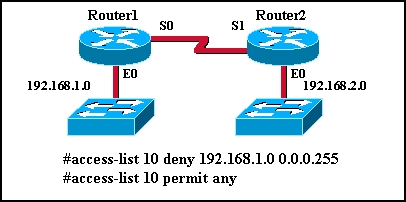
Select the commands that will apply the ACL in the diagram to filter traffic going to the 192.168.2.0 network.

• Router1# configure terminal
Router1(config)# access-list 10 in E0

• outer1(config)# interface ethernet 0
Router1(config-if)# access-list 10 in

• Router2(config)# interface s1
Router2(config-if)# ip access-group 10 out

• Router2(config)# interface ethernet 0
Router2(config-if)# ip access-group 10 out

• Router1(config)# interface ethernet 0
Router1(config-if)# ip access-group 10 out

• Router2# configure terminal
Router2(config)# access-group 10 out

9

Assuming the ACL in the graphic is correctly applied to an interface, what effect will this ACL have on network traffic?
• Host 192.168.15.4 will be denied ftp access to any destination, but will be permitted all other access.
• All ftp traffic to host 192.168.15.4 will be denied.
• All traffic from that interface will be denied.
• No traffic will be denied because a "permit" statement does not exist in this ACL.

10

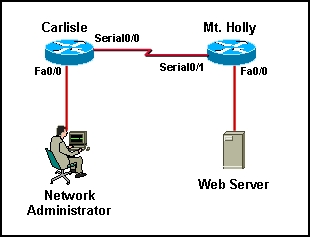
Refer to the exhibit. The network administrator has connectivity to the routers and networks in the diagram. An ACL has been created to allow the network administrator FTP access to the webserver. This ACL must also deny FTP access to the server from the rest of the hosts on the LAN. Which interface in the exhibit is the recommended location to apply the ACL?
• FastEthernet 0/0 on the Carlisle router
• Serial 0/0 on the Carlisle router
• Serial 0/1 on the Mt. Holly router
• FastEthernet 0/0 on the Mt. Holly router

11 Select the correct statements about extended ACLs. (Choose two)
• Extended ACLs use a number range from 1-99.
• Extended ACLs end with an implicit permit statement.
• Extended ACLs evaluate the source and destination addresses.
• Port numbers can be used to add greater definition to an ACL.

• Multiple ACLs can be placed on the same interface as long as they are in the same direction.

12 The following commands were entered on a router:

Router(config)# access-list 2 deny 172.16.5.24
Router(config)# access-list 2 permit any

What can be concluded about this set of commands?
• The access list statements are misconfigured.
• All nodes on 172.16.0.0 will be denied access when these statements are applied.
• The default wildcard mask, 0.0.0.0 is assumed.
• The default wildcard mask 255.255.255.255 is assumed.

13 Where should a standard access control list be placed?
• close to the source
• close to the destination
• on an Ethernet port
• on a serial port

14 A router that has two Ethernet interfaces and one serial interface is configured to route both IP and IPX. What is the maximum number of IP ACLs that can be configured to filter packets on this router?
• 1
• 2
• 3
• 6
• 12

15 Which statement is true regarding wildcard masks?
• The wildcard mask and subnet mask perform the same function.
• The wildcard mask is always the inverse of the subnet mask.
• A "0" in the wildcard mask identifies IP address bits that must be checked.
• A "1" in the wildcard mask identifies a network or subnet bit.

16 ACL statements operate in sequential, logical order. If a condition match is true, the rest of the ACL statements are not checked. If all of the ACL statements are unmatched, what happens to the packet?
• The packets will be placed in a buffer and forwarded when the ACL is removed.
• The packets will be sent to the source with an error notification message.
• The implicit permit any statement placed at the end of the list will allow the packets to flow through uninhibited.
• The implicit deny any statement placed at the end of the list will cause the packets to be dropped.

17 Which of the following matches an ACL identification number with the correct protocol?(Choose three.)
• 0 - standard IP
• 99 - standard IP
• 100 - extended IP

• 210 - extended IP
• 678 - extended IPX
• 888 - standard IPX

18 The router IOS tests each condition statement in an ACL in sequence. Once a match is made, which of the following occurs? (Choose two.)
• The entire ACL must be deleted and recreated.
• The accept or reject action is performed.
• The packet is forwarded to the next hop.
• The remaining ACL statements are not checked.
• The router goes through the list again to verify that a match has been made.

19

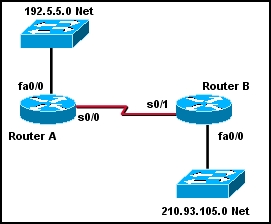
Create a standard ACL that will deny traffic from 192.5.5.25 to the 210.93.105.0 network but will allow traffic from all other hosts. (Choose two.)

• Router(config)# access-list 22 deny 192.5.5.25 0.0.0.0

• Router(config)# access-list 22 deny host 192.5.5.25 0.0.0.0
Router(config)# access-list 22 permit any any

• Router(config)# access-list 22 deny 192.5.5.25 0.0.0.0
Router(config)# access-list 22 permit any

• Router(config)# access-list 22 deny host 192.5.5.25
Router(config)# access-list 22 permit any

• Router(config)# access-list 22 deny 192.5.5.0 0.0.0.255
Router(config)# access-list 22 permit any

1 Which of the following describe how TCP adds reliability to communication? (Choose three.)
• Hosts using TCP set up virtual circuits at the beginning of the transmission using the three-way handshake.
• Hosts using TCP set the error-checking frequency at the beginning of the transmission and maintain this frequency for the duration of the data transfer.
• When a sending host does not receive an acknowledgment within a timed interval it retransmits data.
• The receiving host acknowledges that it has received the expected number of segments and requests additional data.

• The receiving host acknowledges any incorrectly received data and requests retransmission of damaged or missing bytes.
• The sending host transmits each segment twice to ensure that data is not lost.

2 A computer programmer is developing software that requires a reliable stream of data. Which protocol can be used in the software design to eliminate the need for building error detection and recovery into the application program?
• TCP
• IP
• ICMP
• UDP
• HTTP

3 Why is TCP considered a connection-oriented protocol?
• It establishes a virtual connection between hosts using a two-way handshake.
• It uses IP to guarantee delivery of packets between hosts.
• It requires hosts to go through a synchronization process prior to data transmission.
• It creates a connection that depends on application layer protocols for error detection.

4 At which point in the transmission process are segments numbered?
• when received
• when reassembling
• before transmission
• while negotiating window size

5 What is dynamically assigned by the source host when forwarding data?
• destination IP address
• destination port number
• default gateway address
• source IP address
• source port number

6 How are originating source port numbers assigned during the data encapsulation process?
• assigned manually by the user when starting the application
• assigned dynamically by the source host
• assigned by the routing protocol during the lookup process
• assigned by the destination host during session negotiation

7 Which of the following would an administrator do to defend against a denial of service SYN flooding attack? (Choose two.)
• Hide the source of incoming IP addresses.
• Decrease the connection timeout period.
• Synchronize all host communication.
• Increase the connection queue size.
• Flood the network with false SYN requests.

8 When a host receives a data segment, what allows the host to determine which application should receive the segment?
• IP source address
• IP destination address
• PAR
• sliding window
• port number
• SYN packet

9 What is used by UDP to determine if the data or header has been transferred without corruption?
• lower layer protocols
• checksum
• PAR
• sliding window
• acknowledgment and retransmission
• IP

10 What is the purpose of using port numbers in the transport layer?
• to identify the segment as being either TCP or UDP
• to provide reliability during data transport
• to identify the interface port number used by the router when forwarding data
• to track multiple conversations that occur between hosts

11 In the TCP header, which of the following determines the amount of data that can be sent before receiving an acknowledgment?
• segment number
• priority number
• window size
• value in the length field
• value in the port field
• acknowledgment number

12 What does TCP use to ensure reliable delivery of data segments?
• upper layer protocols
• lower layer protocols
• sequence numbers
• port numbers

13 Which of the following protocols uses UDP for transport layer services?
• SMTP
• HTTP
• DNS
• FTP

14 What type of segment and data is shown in the graphic?
• a UDP segment carrying e-mail traffic
• a TCP segment carrying FTP traffic
• an IP segment carrying FTP traffic
• a UDP segment carrying web traffic
• a TCP segment carrying web traffic
• an IP segment carrying e-mail traffic

15 What is the purpose of Positive Acknowledgment and Retransmission (PAR)?
• PAR allows the presentation layer to request that data be resent in a format the destination host can process.
• PAR provides a mechanism for the receiving device to request that all segments be retransmitted if one segment is corrupt.
• PAR helps ensure that a number of data segments sent by one host are received by another host before additional data segments are sent.
• PAR is used to renegotiate the window size during the synchronization process.

16 Which of the following are functions of the TCP protocol? (Choose three.)
• translation of data
• synchronization
• path determination
• flow control
• data representation
• reliability

17 What is used by both TCP and UDP when creating a segment?
• IP address
• MAC address
• IPX address
• socket or port number
• acknowledgment number
• sequence number

18 Which authority has control over the assignment of port numbers for applications?
• IEEE
• IANA
• InterNIC
• Software Developers Association

19 Which of the following describe types of port numbers that can be represented in the headers of TCP and UDP segments? (Choose three.)
• connectionless
• well-known
• operational
• dynamic
• registered

• static

20 What is the purpose of the three-way handshake that occurs between hosts using TCP as the transport layer protocol?
• to increase the number of packets that can be sent before an acknowledgment is required
• to allow a host to forward data to a router
• to establish a round trip connection between sender and receiver before data is transferred
• to provide a mechanism for data encryption and compression

21 During the encapsulation process, in which order are the IP address, MAC address, and port number assigned when the router is establishing communication with the TFTP server?
• IP address, MAC address, port number
• MAC address, IP address, port number
• port number, IP address, MAC address
• port number, MAC address, IP address

22 Which of the following describes a type of denial of service attack designed to exploit the normal function of the TCP three-way handshake?
• A host sends a packet with a spoofed source IP address.
• A host sends a packet with an incorrect destination IP address.
• A source sends a packet containing a garbled header.
• A host sends an oversized packet that fills the memory buffers of the destination host.
• A host sends a packet that contains a virus.
• A host sends a packet that contains a worm.

23 Which transport layer unit of information places the port number in the header?
• data
• segment
• packet
• frame
• bit

1

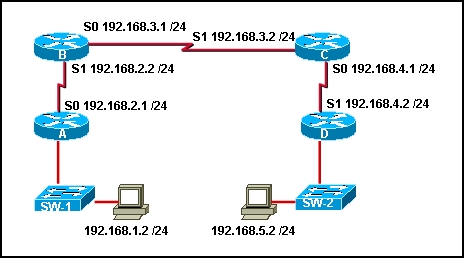
After issuing the command traceroute 192.168.4.2 from Router A, the following information is returned

Tracing the route to Router_D (192.168.4.2)
1 Router_B (192.168.2.2) 16 msec 16 msec 16 msec
2 * * *
3 * * *

What can be concluded about the network shown in the graphic based on the output given?
• Network 192.168.5.0 is missing from the routing table on Router
• There is a problem with the connection between Router B and Router C.
• Router C is not running CDP.
• Some of the routers are non-Cisco devices.
• Router B was not able to return ICMP TEMs to Router A

2 Which of the following would be the default administrative distance of a static IP route that references the IP address of the next hop?
• 0
• 1
• 5
• 20

3 After issuing the show interfaces command, a technician notices the line "Serial1 is down, line protocol is down" in the output. Which of the following are possible reasons for this message output? (Choose three.)
• There is a mismatch in the encapsulation type on both ends of the link.
• A Layer 1 issue exists.
• An interface problem exists.

• The clockrate was not set during configuration.
• There is no usable media for the protocol.
• Keepalive messages are not being sent.

4 Which three correctly pair a routing metric with its description? (Choose three.)
• hop count - the number of routers traversed to reach a destination
• bandwidth - the amount of time it takes a packet to travel a link
• load - the amount of activity on a link
• delay - the link speed
• reliability - the error rate on a link

5

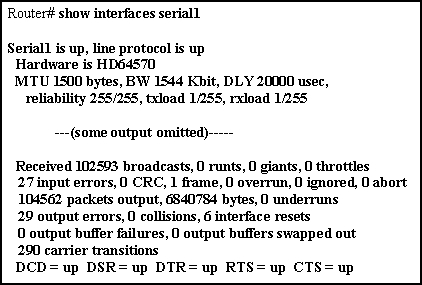
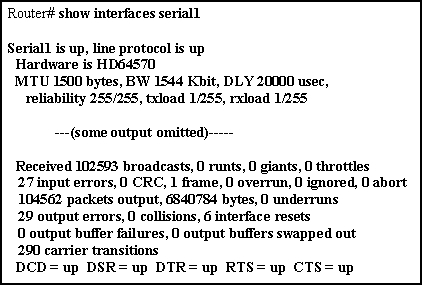
When issuing the show interfaces serial1 command, a network administrator receives the output shown in the graphic. What are the possible causes of an increase in the number of input errors? (Choose three.)
• There could be Layer 3 addressing problems.
• There could be a problem with faulty telephone equipment.
• The router hardware could be defective.

• There is an incorrectly configured encapsulation on the interface.
• There could be a problem with the cabling.

6 Which ICMP message type notifies source hosts that a receiving host or network is not available?
• time exceeded
• redirect
• destination unreachable
• source quench
• parameter problem
• echo reply

7 The show interfaces command provides line and protocol status information. Which of the following conditions would never occur in the output of this command?
• serial1 is up, line protocol is up
• serial1 is up, line protocol is down
• serial1 is down, line protocol is down
• serial1 is down, line protocol is up
• serial1 is administratively down, line protocol is down

8

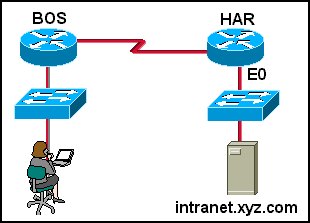
The network administrator shown in the exhibit can ping the E0 interface of the HAR router, but the telnet intranet.xyz.com command issued from the administrator's workstation fails to open a session with the intranet.xyz.com server. What are two possible causes of this problem? (Choose two.)
• upper-layer application problems
• domain name system problems

• IP addressing problems on the HAR router
• clock rate problems on the HAR router serial interface
• ICMP connectivity problems

9 The network administrator is using a PC to access a router via the router console port. Both the PC and the router are powered on and a cable has been connected between them. However, a session cannot be established. Which steps might fix this problem? (Choose two.)
• Verify the cable is properly connected at each end.
• Reseat the network card in the PC.
• Verify the cable is the correct type.
• Verify that a password has been set on the console line.
• Check the transceiver for link lights.
• Reseat the console card on the router

10 Which command will display routing table information about all known networks and subnetworks?
• Router# show ip interfaces
• Router# show ip connections
• Router# show ip route
• Router# show ip networks

11 A network technician has discovered that a router in the network can no longer be reached. The technician attempts to verify Layer 1 functionality, but is unable to physically inspect the cables. Which command can be used to determine the type of cable connected to the router?
• Router# show interfaces
• Router# show controllers serial
• Router# show ip route
• Router# show ip protocol
• Router# show version
• Router# show running-config

12 During the lookup process when forwarding a packet, a router checks its routing table for the best path to the destination. If a route has an administrative distance of 0, what does this indicate to the router?
• The packet should be discarded.
• The destination is unreachable.
• The destination is a directly connected network.
• The source of the update for that route is unreliable.

13 Which command will verify the functionality of all seven layers of the OSI model on a network host?
• ping
• debug
• telnet
• traceroute

14

After issuing the show interfaces serial1 command, an administrator notices an increasing number of carrier transitions. What are the possible causes for this increase? (Choose two.)
•There is an incorrect encapsulation configured on the interface.
•There could be an interruption in the line by the service provider.
•There is a faulty switch or CSU/DSU.

•There is noise on the serial line.

15

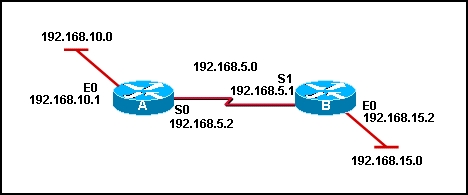
Consider the RIP network shown in the diagram. Which entries would be listed in the routing table of Router A?
• R 192.168.5.2[120/1] via 192.168.15.0, 00:00:09, Serial0
• R 192.168.15.0[120/1] via 192.168.5.2, 00:00:13, Serial1
• R 192.168.15.0[120/1] via 192.168.5.1, 00:00:13, Serial0
• R 192.168.5.1 [120/1] via 192.168.5.2 00:00:29, Serial1
R 192.168.15.0 [120/1] via 192.168.5.2, 00:00:29, Serial1
• R 192.168.5.1 [120/1] via 192.168.5.2 00:00:18, Serial0
R 192.168.15.2 [120/1] via 192.168.5.2, 00:00:18, Serial

16 Which items would be displayed when the show ip protocols command is executed? (Choose three.)
• sources of routing updates
• networks being advertised

• routing protocol up or down
• configured routed protocols
• Layer 2 status of the interface
• update timer values

17 Which two are true regarding the debug commands? (Choose two.)
• Debug commands may be issued from the user EXEC prompt.
• The command undebug all will turn off all debug operations.
• By default, the router sends the debug output and messages to the telnet session.
• The high processor overhead incurred using debug may disrupt normal router operation.
• The debug all command provides a summary view of router activity and can be used frequently for troubleshooting.
• The show debugging command will display current events such as traffic on an interface and error messages generated by nodes on the network.

18 A network administrator suspects that a network is not being included in the routing updates. Which command will provide information on when the next update is due and which networks are advertised in the update?
• Router# show interfaces
• Router# show controllers serial
• Router# show ip protocols
• Router# show ip route
• Router# show running-config

19 Which of the following is a problem at the physical layer of the OSI model?
• incorrect file formatting
• incorrect encapsulation on a serial interface
• incorrect routing protocol
• incorrect cable type

20

When the show cdp neighbors command is issued from Router C, which devices will be displayed in the output?
• D, SWH-2
• A, B, D
• SWH-1, SWH-2
• B, D
• SWH-1, A, B
• A, B, D, SWH-1, SWH-2

21 Which of the following are advantages of using a static route? (Choose three.)
• secure operation
• highly adaptable
• low maintenance configuration
• low processor overhead
• precise control of path selection

22 Which of the following commands can be used to statically configure default routes? (Choose two.)
• ip static-route
• ip route
• ip network-route
• ip default-network
• ip default-static

23 Why does a router build a routing table? (Choose two.)
• to list available routes for forwarding data
• to map local Layer 2 addresses to the remote Layer 3 destination address
• to dynamically send periodic updates regarding the router's status
• to prevent routing loops when redundant links are added to the network
• to select the best path to a destination

24 Which of the following lines from the show interfaces output would indicate a Layer 2 problem?
• Serial1 is up, line protocol is up.
• Serial1 is up, line protocol is down.
• Serial1 is down, line protocol is down.
• Serial1 is administratively down, line protocol is down.

1 How does a source host use ICMP to confirm that a destination host is reachable?
• The source host sends an ICMP echo request to the destination router which responds with an ICMP echo reply confirming the reachability of the destination host.
• The source host sends a data packet and receives an ICMP host unreachable packet from the destination host if the data packet cannot be delivered.
• The source host sends an ICMP packet with a TTL value of 1 and receives an ICMP reply with a TTL value of 0 from the destination host.
• The source host sends an ICMP echo request and receives an ICMP echo reply from the destination host.

2 Which type of message is generated by a host when the ping command is entered?
• ICMP echo request
• ICMP echo reply
• UDP echo request
• UDP error message

3 Which of the following start the test of destination reachability?
• echo request issued by source
• echo reply issued by source
• echo request issued by destination
• echo reply issued by destination

4 Which two statements are true regarding ICMP? (Choose two.)
• ICMP provides reliability for the TCP/IP protocol stack.
• ICMP is a component of the TCP/IP protocol stack.
• ICMP notifies the sender that data transmission errors have occurred.

• ICMP is connection-oriented.
• ICMP messages are propagated to all intermediate devices.

5 How does ICMP improve data transfer reliability in IP networks?
• Each router in the path reads ICMP packets and uses the information to update routing tables.
• ICMP can correct many network problems as they occur.
• ICMP error messages are returned to the sending device when a packet is dropped by a router.
• ICMP packets report the intermediary devices that a packet passed through before failure occurred.

6 Which layer protocols provide reliability for IP when needed?
• ICMP and ping
• RIP and TTL
• upper layer protocols
• lower layer protocols
• Internet layer protocols
• network access layer protocols

7 Which devices along a data transmission path are notified by ICMP when delivery failures occur?
• source devices only
• destination devices only
• intermediary devices
• source and destination devices
• source, intermediary, and destination devices

8 When a datagram is processed by a router on the path from source to destination, what happens to the value in the TTL field?"
• It is increased by one.
• It is decreased by one.
• It stays the same.
• It is reset to 0.
• Nothing.

9 Which condition could cause a fragmentation needed ICMP destination unreachable message to be sent?
• A low bandwidth WAN link has become congested with IP traffic.
• A packet is forwarded from a Token Ring network to an Ethernet network.
• A network is not reachable because of faulty routing information.
• The address specified by the sending host is nonexistent.

10

Workstation 1 sent a data packet to Workstation 4. It never arrived because Fa0/0 interface went down on Router C. How will the devices handle this failure?
• Workstation 4 will send an error message to Router C and Workstation 1 that it did not receive the packet.
• Router C will use ICMP to send a message back to Workstation 1 indicating that the packet could not be delivered.
• Router C discards the packet without providing notification to any device.
• Router C uses ICMP to correct the failure and transmits the data to Workstation 4.
• Workstation 1 will use ICMP to correct the problem and then notify Router C to continue the transmission.

11 Which three conditions must be met in order for host to host communication over an internetwork to occur on IP networks? (Choose three.)
• The routing protocols configured on the source and destination networks must be the same.
• A default gateway must be properly configured on the hosts and local networks.
• Intermediary devices, such as routers, must be present on the network and have knowledge of how to reach the destination network.

• The source and destination host subnet masks must match.
• The IP addresses of the hosts must be in the same network or subnet as their respective gateway devices.

1 Which command or set of commands will stop the RIP routing process?
• RouterB(config)# router rip
RouterB(config-router)# shutdown
• RouterB(config)# router rip
RouterB(config-router)# network no 192.168.2.0
• RouterB(config)# no router rip
• RouterB(config)# router no rip

2 When does a distance vector routing protocol set a hold-down timer on a route?
• when the metric value of the route decreases
• when the route is marked as inaccessible
• when the metric value for the route improves
• when a regular update is received from a neighboring router

3 Which of the following functions are performed by a router as routing information travels through the network? (Choose two.)
• advertise supported applications
• identify new destinations
• calculate packet speed
• verify network scalability
• identify invalid networks

4 What do distance vector algorithms require each router in the network to send?
• a partial routing table to each router in the LAN
• a partial routing table to each router in the WAN
• the entire routing table to each neighboring router
• the entire routing table to each router in the autonomous system

5

What actions will occur after RouterA loses connectivity to network 114.125.16.0? (Choose two.)
• RouterB will include network 123.92.76.0 and 136.125.85.0 in its update to RouterA.
• During the next update interval, RouterB will send a RIP update out both ports that includes the inaccessible network.
• During the next update interval, RouterC will send an update to RouterB stating that network 114.125.16.0 is accessible in 2 hops.
• Router C will learn of the loss of connectivity to network 114.125.16.0 from RouterB.
• RouterB will include network 123.92.76.0 and 136.125.85.0 in its update to RouterC.

6

Refer to the exhibit. Assuming default settings are configured, which routing protocol has been configured on the router?
• OSPF
• RIP
• EIGRP
• BGP
• Static

7 Which command will display RIP activity as it occurs on a router?
• debug ip rip
• show ip route
• show ip interface
• show ip protocols
• debug ip rip config
• show ip rip database

8 Which of the following methods does split horizon use to reduce incorrect routing information?
• Routing updates are split in half to reduce the update time.
• Information learned from one source is not distributed back to that source.
• New route information must be learned from multiple sources to be accepted.
• The time between updates is split in half to speed convergence.
• New route information is suppressed until the system has converged.

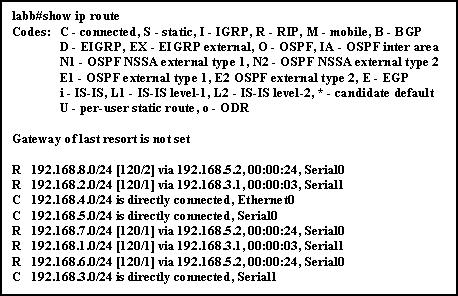
9

According to the router output from the show ip route command shown above, which of the following statements are true? (Choose two.)
• The metric to network 192.168.8.0 is 24.
• The hop count to a device on network 192.168.8.0 is 2.
• The total path cost to network 192.168.4.0 is the default value of 16.
• The logical address of the next router for network 192.168.1.0 is 192.168.3.1.
• The devices on network 192.168.5.0 cannot be reached as indicated by the 'C' label.

10 How would an administrator configure a static route for use if a primary route failed?
• configure the route with a metric greater than the default value
• configure the route and the router will activate it as needed
• configure the route to activate by using the redistribute static command
• configure the route with an administrative distance greater than the default value

11 Which statements describe RIP? (Choose three.)
• The maximum metric value is 255 hops.
• The maximum metric value is 15 hops.
• Routing updates occur every 30 seconds.
• Routing updates occur every 90 seconds.
• It is a distance vector routing protocol.
• It is a link state routing protocol.

12 A router has routes to several subnets of a classful network in its routing table. A default route is defined on the router but the ip classless command is disabled. If the router receives packets for a subnet that is not in its routing table but is in the same classful network as the other subnets, what will happen to the packets?
• The packets will be forwarded using the default route.
• The packets will be forwarded using a route to one of the other subnets of the classful network.
• A nonreachable message will be returned to the source.
• The packets will be discarded.
• The router will generate a new route to the subnetted network.

13

The administrator of the network depicted in the graphic would like to decrease the network's convergence time. How can this be accomplished?
• disable split horizon on the routers
• increase the update interval on the routers
• change the RIP holddown timer to 96 seconds
• change the RIP holddown timer to 226 seconds

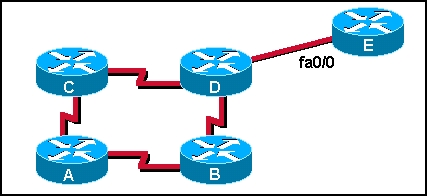
14

If the passive interface command is enabled on the fa0/0 interface of Router E, which statements are true? (Choose two.)
• Router E will send all routing updates via interface fa0/0.
• Router E will ignore all routing updates learned via interface fa0/0.
• Router E will use routing updates learned via interface fa0/0.
• Router E will not send routing updates via interface fa0/0.

15 Which statements describe load balancing when RIP is configured as the routing protocol? (Choose two.)
• A router is allowed to take advantage of multiple best paths to a given destination.
• RIP uses the round robin approach in load balancing.
• RIP load balancing selects a single path to forward all data to the destination even though equal parallel paths exist.
• RIP load balancing is based on bandwidth first and then the hop count.
• Only one path to a destination can be statically assigned or dynamically calculated.

16

The graphic shows a network that is configured to use RIP routing protocol. Router2 detects that the link to Router1 has gone down. It then advertises the network for this link with a hop count metric of 16. Which routing loop prevention mechanism is in effect?
• split horizon
• error condition
• hold-down timer
• route poisoning
• count to infinity

17

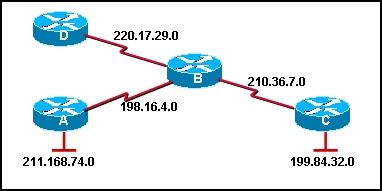
Which of the following would be the correct command sequence to enable RIP on Router B for all connected networks?
• RouterB# router rip
RouterB(router)# network 210.36.7.0
RouterB(router)# network 220.17.29.0
RouterB(router)# network 211.168.74.0

• RouterB(config)# router rip
RouterB(config-router)# network 198.16.4.0
RouterB(config-router)# network 211.168.74.0
RouterB(config-router)# network 199.84.32.0

• RouterB(config)# configure router rip
RouterB(config-router)# network 210.36.7.0
RouterB(config-router)# network 199.84.32.0
RouterB(config-router)# network 211.168.74.0

• RouterB(config)# router rip
RouterB(config-router)# network 198.16.4.0
RouterB(config-router)# network 210.36.7.0
RouterB(config-router)# network 211.168.74.0

• RouterB(config)# router rip
RouterB(config-router)# network 198.16.4.0
RouterB(config-router)# network 210.36.7.0
RouterB(config-router)# network 220.17.29.0

18 When a routing table update is received by a router in a distance vector network, which of the following occurs?
• The hop count metrics for the enclosed routes are incremented.
• The update is forwarded to the gateway router for verification.
• Path entries are checked for routing loops.
• The hop count metrics for the enclosed routes are decremented.
• Static routes are updated with the new information.

19 The following line was displayed in the output of the show ip route command:
192.168.3.0/24 [120/2] via 192.168.2.2, 00:00:30, Serial0/0
What is the administrative distance of the enabled routing protocol?
• 2
• 30
• 100
• 120

20 When does RIP send routing table updates? (Choose two.)
• periodically, every 30 seconds
• periodically, every 60 seconds
• periodically, every 90 seconds
• if optionally configured, when topology changes occur (triggered-update)

21 Which of the following can exist in a distance vector network that has not converged? (Choose three.)
• routing loops
• inconsistent traffic forwarding

• no traffic forwarding until system converges
• inconsistent routing table entries
• routing table updates sent to wrong destinations

22 What happens to a static route entry in a routing table when the outgoing interface is not available?
• The route is removed from the table.
• The router polls neighbors for a replacement route.
• The route remains in the table because it was defined as static.
• The router redirects the static route to compensate for the loss of the next hop device.

1 What can be concluded about the routing process on a router if the commands router rip and network 192.5.5.0 have been issued? (Choose three.)
• A distance vector routing protocol was used.
• A link-state routing protocol was used.
• Routing updates will broadcast every 30 seconds.
• Routing updates will broadcast every 90 seconds.
• Hop count is the metric used for route selection.
• Bandwidth, load, delay, and reliability are the metrics used for route selection.

2 Which two protocols use an addressing scheme to direct user traffic? (Choose two.)
• IP
• EIGRP
• IPX
• OSPF
• RIP

3 What are some of the advantages of using a link-state routing protocol instead of a distance vector routing protocol? (Choose two.)
• The topology database eliminates the need for a routing table.
• Frequent periodic updates are sent to minimize the number of incorrect routes in the topological database.
• Routers have direct knowledge of all links in the network and how they are connected.
• After the inital LSA flooding, they generally require less bandwidth to communicate changes in a topology.

• Link-state protocols require less router processor power than distance vector protocols.

4 If dynamic routing is not configured on a router, how do routing table updates occur?
• Link state advertisements are sent from other routers.
• Updates are made to the routing table by the administrator.
• Best path information is communicated by network hosts.
• The routing table is updated by neighboring routers.

5 Why is fast convergence desirable in networks that use dynamic routing protocols?
• Routers will not allow packets to be forwarded until the network has converged.
• Hosts are unable to access their gateway until the network has converged.
• Routers may make incorrect forwarding decisions until the network has converged.
• Routers will not allow configuration changes to be made until the network has converged.

6 What is the purpose of a routing protocol?
• It is used to build and maintain ARP tables.
• It provides a method for segmenting and reassembling data packets.
• It allows an administrator to devise an addressing scheme for the network.
• It allows a router to share information about known networks with other routers.
• It provides a procedure for encoding and decoding data into bits for packet forwarding.

7 Which are the primary functions used by a router when forwarding data?(Choose two.)
• data encryption
• error notification
• packet switching
• address identification
• path determination
• packet validation

8 How does a router learn about routes to a network? (Choose three.)
• Information is gathered from its own configuration regarding directly connected networks.
• Switches forward destination address information to each router.
• Hosts communicate destination network information to each router.
• Other routers forward information about known networks.
• Routes are entered manually by a network administrator.

• Routes are learned from information gathered from ARP tables.

9 Which type of address does a router use to make routing decisions?
• source IP address
• source MAC address
• destination IP address
• destination MAC address

10 Describe the switching function that occurs in a router.
• allows the router to make forwarding decisions based on Layer 2 addressing
• uses network addressing to select the best route and interface to forward data
• accepts a packet on one interface and forwards it to a second interface
• enables the router to select the most appropriate interface for forwarding a packet

11 Select the statements that describe link-state routing processes? (Choose three.)
• Each router develops its own map of the entire network.
• Routers send triggered updates when changes in the network occur.
• Link-state routing protocols place a higher load on router resources during the routing protocol initialization.

• Link-state protocols are more prone to routing loops than distance vector routing protocols.
• Networks using link-state routing protocols are slower to reach convergence after changes have occurred than those using distance vector protocols.

12 Why is it necessary to specify a list of networks when configuring an interior routing protocol?
• to tell the router how to reach those networks
• to tell the router which attached networks participate in routing updates
• to tell the router which set of metrics to use for the attached networks
• to tell the router which routing protocol to use

13

Assuming that the network shown in the graphic is converged and dynamic routing is enabled, which of the following conditions will cause a modification to the Orlando routing table? (Choose two.)
• The device connecting the S0 interface of the Tampa router to the serial link loses power.
• A network administrator shuts down the Orlando router E0 interface.
• A DCHP server connected to the Tampa E1 network loses power.
• The IP address of a workstation on the Orlando E0 network is reassigned.
• A host on the Orlando E1 network transmits data to a server on the Tampa E1 network.
• A Telnet connection to the Orlando router fails.

14 All routers at a medium sized company have been upgraded. During the upgrade, the network administrator determined that a more advanced routing protocol using a combination of both distance vector and link state features should be implemented. Which protocol should be selected?
• RIP
• BGP
• OSPF
• EIGRP

15 Which category of routing algorithms discovers and maintains a topological map of the entire internetwork?
• static
• Bellman-Ford
• exterior gateway
• Internetwork Packet Exchange
• distance vector
• link-state

16 Which is an exterior routing protocol commonly used between ISPs?
• RIP
• BGP
• OSPF
• EIGRP

17 Which of the following statements are true regarding the command ip route 172.16.1.0 255.255.255.0 172.16.2.1? (Choose three.)
• This command is used to set up a static route.
• This command is used to set up a default route.
• This command is entered from global configuration mode.
• All packets intended for network 172.16.1.0 will be sent to gateway 172.16.2.1.

• All packets intended for network 172.16.2.1 will be sent to gateway 172.16.1.0.

18

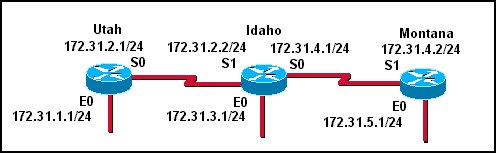
Referring to the diagram, which commands will enable hosts on the Idaho E0 network to reach hosts on the E0 network of the Montana router? (Choose two.)
• Montana(config)# ip route 172.31.5.0 255.255.255.0 172.31.5.1
• Montana(config)# ip route 172.31.3.0 255.255.255.0 172.31.4.1
• Idaho(config)# ip route 172.31.5.0 255.255.255.0 172.31.4.1
• Idaho(config)# ip route 172.31.5.0 255.255.255.0 172.31.4.2
• Idaho(config)# ip route 172.31.5.1 255.255.255.0 172.31.4.1

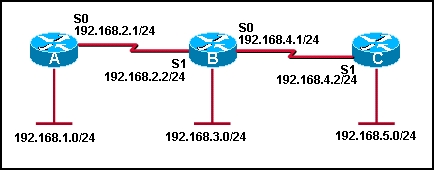
19

Which of the following are valid static IP routes? (Choose three.)
• RouterB(config)# ip route 192.168.5.0 255.255.255.0 S1
• RouterC(config)# ip route 192.168.1.0 255.255.255.0 S1
• RouterA(config)# ip route 192.168.3.0 255.255.255.0 192.168.2.2
• RouterB(config)# ip route 192.168.1.0 255.255.255.0 192.168.2.2
• RouterC(config)# ip route 192.168.2.0 255.255.255.0 192.168.4.1
• RouterA(config)# ip route 192.168.4.0 255.255.255.0 192.168.2.1

20 Given the command, RouterC(config)# ip route 197.5.2.0 255.255.255.0 192.10.1.1, what does the address 192.10.1.1 represent?
• the source host
• the next hop router
• the outbound interface
• the destination network

21 Which of the following conditions must be met in order for a network to have converged?
• The routers in the network are operating with dynamic routing protocols.
• The routers in the network are operating with compatible versions of IOS.
• The routers in the network are operating with the same routing tables.
• The routers in the network are operating with consistent routing knowledge.

22 Which two statements describe autonomous systems? (Choose two.)
• Interior gateway protocols are used between autonomous systems.
• Exterior gateway protocols are used between autonomous systems.
• An autonomous system may be under the control of multiple organizations.
• An autonomous system is identified by a 16 bit number assigned by ARIN.
• The autonomous system is identified in the network portion of the IP address.

1 Which command will display the source of the system boot image?
• Router# show version
• Router# show config-register
• Router# show start-up config
• Router# show running-config
• Router# show flash

2 Routers have different types of memory. Choose the answer that describes flash memory.
• provides working storage
• stores a fully functional IOS image
• stores the startup configuration file
• initializes the code used to boot the router

3 Routers have different types of memory. Choose the answer that describes NVRAM.
• provides working storage
• stores a fully functional IOS image
• stores the startup configuration file
• initializes the code that is used to boot the router

4 Which command will backup configuration files from RAM to NVRAM or a TFTP server?
• backup
• copy
• telnet
• move

5 Which two items below are required by routers in order for them to perform their basic operations? (Choose two.)
• a tftp server
• a configuration file
• a configuration register file
• an operating system file
• a DNS table

6 An IOS image can be copied into flash from a TFTP server. Which of the following statements are true regarding this process? (Choose three.)
• A series of "!'s" are displayed as the image is downloaded successfully to flash.
• The copy tftp flash:filename ip address command is used to copy the IOS from the server to flash.
• After the new flash image is downloaded, it is verified.
• A series of "e's" are displayed as the current IOS image is erased from flash.

• Flash must be cleared with the erase command prior to beginning the download process.

7 Which part of the configuration register indicates the location of the IOS?
• the bootstrap
• the boot field
• the IOS locator
• the system image loader

8 Which of the following can be configured as a source for the IOS image by using the boot system command? (Choose two.)
• TFTP server
• HTTP server
• Telnet server
• Flash memory
• NVRAM memory

9 Which command is used to change the order in which the router looks for system bootstrap information?
• config-image
• config-system
• config-register
• config-bootfield
• config system bootstrap

10 Which command will copy an IOS image from a TFTP server to a router?
• Router# copy tftp flash
• Router# copy flash tftp
• Router(config)# copy tftp flash
• Router(config)# copy flash tftp

11 What command can be used in ROM monitor mode to run the IOS image in flash?
• rommon1> config-register 0x2102
• rommon1> boot flash:filename
• rommon1> xmodem:filename
• rommon1> boot system flash:filename
• rommon1> reload system flash:

12 The Cisco IOS image naming convention allows identification of different versions and capabilities of the IOS. What information can be gained from the filename c2600-d-mz.121-4? (Choose two.)
• The "mz" in the filename represents the special capabilities and features of the IOS.
• The file is uncompressed and requires 2.6 MB of RAM to run.
• The software is version 12.1, 4th revision.
• The file is downloadable and 121.4MB in size.
• The IOS is for the Cisco 2600 series hardware platform.

13 Where does a router look for boot system statements?
• ROM
• RAM
• NVRAM
• Flash

14 What does a configuration register setting of 0x2102 indicate on a router?
• It tells the router to locate and load the IOS from NVRAM.
• It tells the router to locate and load the IOS from FLASH.
• It tells the router to bypass the configuration in NVRAM.
• It tells the router to look in the startup configuration for boot system commands.

15 If a router cannot find a valid configuration file during the startup sequence, what will occur?
• The startup sequence will reset.
• The router will prompt the user for a response to enter setup mode.
• The startup sequence will halt until a valid configuration file is acquired.
• The router will generate a default configuration file based on the last valid configuration.
• The router will monitor local traffic to determine routing protocol configuration requirements.

16 If the configuration register instructs a router to look for configuration information in NVRAM and no boot system commands exist there, from where will the router next attempt to boot the IOS?
• RAMR
• ROM
• FLASH
• EPROM
• ROMMON

17 If boot system commands have been configured, which of the following could happen if a router fails to obtain an IOS image from the primary sources during bootup?
• The router will load a subset of a full IOS version from system ROM.
• The router will attempt to reboot two times before failing.
• The router will load the last good IOS image from NVRAM.
• The administrator will be prompted to load a valid IOS image.

18 The router has been configured with a valid configuration file. Which of the following could be a cause for a router not booting normally? (Choose two.)
• The flash image is corrupt.
• A console cable is disconnected.
• The flash image is located in NVRAM.
• The startup configuration file is incomplete.
• The router encountered a hardware error.

19 Which of the following are steps in saving a router configuration file to a TFTP server? (Choose three.)
• Enter configuration mode.
• Enter the IP address to the TFTP server.
• Use the copy running-config tftp command.

• Use the copy tftp running-config command.
• Name the configuration file or accept the default name.

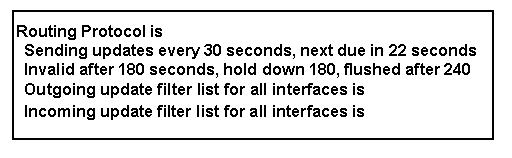
1 A network administrator was called away from the terminal while using Telnet to monitor a remote router. The Telnet session was left connected. If the default Telnet configuration is used, what will the administrator find upon returning 15 minutes later?
• The Telnet session entered a "sleep" state and will resume when the spacebar is pressed.
• The Telnet session remained connected and is on the same screen it was left on.
• The Telnet session suspended itself and will resume when the Enter key is pressed.
• The Telnet session terminated itself after 10 minutes of inactivity.
• The Telnet session remained active but now requires the password to be entered again.

2 What is the main use of Telnet?
• transfer of data between end users
• verification of simple connectivity
• routing of data packets
• remote connection to network devices

3

Which of the following is true regarding CDP and the graphic shown?
• CDP running on Router D will gather information about routers A, B, C, and E.
• By default, Router A will receive CDP advertisements from routers B and C.
• If routers D and E are running different routing protocols, they will not exchange CDP information.
• Router E can use CDP to identify the IOS running on Router B.

4 Which of the following are displayed by the Router# show cdp neighbors command? (Choose three.)
• load
• platform
• reliability
• holdtime
• local interface

5 To obtain CDP information from a Cisco router that is not directly connected to the administrator's console, what must happen?
• The source router must send TLV blocks to the remote router.
• The administrator can Telnet to a Cisco device that is connected to the remote router.
• The administrator needs to issue the Router# show cdp all to view the entire network CDP advertisements.
• The administrator must transmit TTL packets to the remote device and wait for a response.

6 What is the purpose of the cdp timer command?
• specifies the hold time to be sent in the CDP update packet
• resets the traffic counters back to zero
• specifies how often the Cisco IOS software sends CDP updates
• deletes and resets the CDP table of information about neighbors

7 An administrator is attempting to enable CDP on the interface of a Cisco router. After issuing the command Router(config-if)# cdp enable, the router responds with an error stating that CDP is not active. What might be the problem?
• The cdp enable command must be issued from the global mode prompt.
• The administrator needed to issue the command Router(config-if)# cdp run.
• CDP has not been configured globally.
• The administrator did not manually enter the CDP neighbors into the CDP table.

8

The traceroute command was used to trace the path between routers A and D. What would an output display of three asterisks (***) indicate?
• The command was issued from the wrong prompt.
• Each datagram was successfully sent.
• One of the routers is unreachable.
• There are three hops between source and destination.

9

Pings between Atlanta and Dallas are successful. If a hostname table or DNS connection is not available, which command will successfully establish a remote connection from Atlanta to Dallas via Telnet?
• Atlanta> connect Dallas
• Atlanta> 197.72.3.2
• Atlanta# 206.157.85.1
• Atlanta# telnet Dallas

10 How many Telnet sessions can take place simultaneously on a router running a standard edition of the IOS?
• 4
• 5
• 8
• 10

11 Why would an administrator use the Telnet application when troubleshooting a network? (Choose three.)
• It can be used to verify the operation of application layer software between the source and destination.
• Telnet can use the ICMP protocol to verify a hardware connection and network layer address.
• It is the most complete testing mechanism available.
• Remote networks may be accessed via a Telnet session for troubleshooting.

• Time to Live values are used by Telnet to identify a failure of device between source and destination.

12 For which three network layer protocols does CDP provide information? (Choose three.)
• IP
• RIP
• SNMP
• AppleTalk
• IPX

• EIGRP

13

If the network administrator establishes a telnet session from Workstation 2 to GAD and then from GAD to BHM, what occurs if the session with BHM is suspended and the Enter key is pressed?
• The GAD session will be resumed.
• The BHM session will be resumed.
• The GAD session will be terminated.
• The BHM session will be terminated.

14 Transmitting type length values (TLVs) inside advertisements is a process used by CDP to provide information about neighboring devices. What information is displayed by these TLVs? (Choose three.)
• interface information of the connected device
• all networks connected to the neighboring device
• name of the connected device
• routing protocol used on the neighboring device
• holdtime for advertisements

15

Which command will produce the output shown in the graphic?
• show cdp
• show cdp neighbors
• show cdp neighbors detail
• show cdp detail
• show cdp traffic

16 What key sequence is used to suspend a Telnet session on a remote router?
• Ctrl-Shift-S
• Ctrl-Shift-6
• Ctrl-Shift-6, then x
• Ctrl-Alt-S
• Ctrl-Alt-6
• Ctrl-Alt-6, then x

17 What command enables CDP on the interface of a router?
• Router(config-if)# cdp enable
• Router(config-if)# cdp run
• Router(config-if)# cdp start
• Router(config-if)# cdp config

18 How can a network administrator logged in to RTA gather information about the Cisco devices that are directly connected to its neighbor, RTB?
• Use the show cdp neighbors detail command on RTA to view information about every device on the entire internetwork.
• Use ping to determine the status of RTB, then issue the show cdp neighbors detail command.
• Use Telnet to connect to RTB, then issue the show cdp neighbors command.
• Use traceroute to establish the pathway to RTB, then issue the show cdp neighbors command.